Late on Monday afternoon in the third week of August I was leading a group of adult students down a green run. We were working on lateral balance using outside pole drags and were using the steeper pitch as I had been warned at lunch time that the runs at Captains were diabolical. There were so many out of control riders the instructors were getting concerned for their safety, and that of their guests.
The steep pitch merged into a much wider less steep slope so I looked up the hill to the right because the easier slope to the right tended to direct people in a diagonal fashion to intersect with our more direct route down the fall line. And before I had time to respond a snowboarder straight lining at great speed collided with me side on and I went flying.
The snowboarder was going very fast, at least 40km/hour and was using neither edge on his board to turn or control his speed. He was heading straight down the hill, and when he saw me he simply ran straight into me. I always tell my beginner skiers that the best way to avoid running into people is to look at the space next to them and that's how you avoid them. This guy saw me, had no control anyway, and hit me.
Apparently I fly really well! Because of the side on impact I ejected sideways out of my skis, so my airborne trajectory was not hampered by skis. Which meant my legs escaped any injury at all. Not so the rest of me.
I landed crumpled on my right side, and was winded, finding it very difficult to breathe. I rolled over onto my back, no skis made that easy, and I could breathe better, but I knew straight away I was badly injured.
Help came quickly. One of my colleagues was teaching nearby, so she collected my skis and my students and got them safely down the mountain. Ski Patrol assessed me and called for medical assistance, as it became clear pretty quickly that not only had I broken my forearm, but also my ribs and pelvis, and there was concern that I had intra abdominal trauma.
After further assessment by the medical team I was transferred in the ski stretcher to the on mountain medical centre, where I was prepared for immediate helicopter evacuation to Dunedin Hospital. A chopper was already there, called for another patient, but they got bumped as my condition was more serious.
Luckily, my head and spine were completely spared.
The chopper flight was short and sweet, though no views for me. Soon we were landing on the roof at Dunedin Hospital and I was taken to Emergency where an ultrasound scan of my abdomen revealed no free fluid. I was sent around to CT to get a better assessment, where they found six fractured ribs and three fractures in my pelvis consistent with a lateral compression pelvic ring injury. All on the right side. My abdominal and pelvic organs were intact. No liver or kidney/bladder tears.
My forearm was well and truly smashed. Both radius and ulna were broken mid shaft, with considerable fragments and a lot of displacement and angulation. They sedated me to reduce the fracture a little and put it in a back slab, but it needed surgery to fix it properly.

I was then sent up to the ward to await surgery. Which could take days, but I had so many injuries that was the least of my problems.
Between the rib and pelvis fractures and with one arm out of action, and the amount of pain I was in, I couldn't pass urine using a bedpan, so I requested an indwelling catheter. The night house officer couldn't give his consent without checking with his superior, so in the end the nurse looking after me took the initiative and just popped one in. Oh the relief!!
I really couldn't move much, and nor could I take deep breaths, so the next day I was visited by Eileen, the orthopaedic nurse specialist, and she arranged for the pain team to see me and put a cannula in to my chest wall that would deliver a dose of local anaesthetic around my fracture site every 20 minutes. Getting into position to have the procedure done was excruciating, as was lying there whilst the ultrasound guided needle was placed in just the right position. I actually needed two cannulas to provide full pain relief, but by the time they had placed the first one I was no longer coping, and needed to return onto my back again. But the ribs that were anaesthetised were helping to improve my breathing so it was enough.
During my entire time in Dunedin I was told that I just had one fracture in my pelvis. This was obvious on the plain Xray, whereas the other fractures were only seen on the CT scan. This poor communication meant that everyone assumed I had a minor stable pelvic fracture, so there was a plan for early mobilisation. Despite the fact that I could feel things moving in my pelvis and that any time I rolled onto my left side and allowed the right buttock to not be supported I was in excruciating pain.
Tuesday and Wednesday I was fasted for surgery all day, and then told around 4:30 that I wouldn't get operated on, so a sandwich for dinner was my reward. Hard to heal when they nutritionally starve you!! On Thursday, however, I at last went to theatre, and four hours later my poor forearm was repaired with a few plates and screws, and replastered. Post operatively I struggled with the pain, and the opiate analgesia suppressed my breathing, so I ended up on a type of C-PAP machine overnight.
I hardly slept all night, as the analgesia was inadequate and the arm throbbed dreadfully. The next morning the orthopaedic registrar elevated my arm and the pain eased almost instantaneously, so Eileen organised for a good old fashioned cast sling to be pulled out of the dusty storeroom for my use. The pain team came around and changed my medication to oral opiates and increased the dose. That gave me the best pain relief of the last few days, but unfortunately also suppressed my breathing. After a few tears we at last came to a compromise of more regular doses of 10mg Morphine, and I had my first comfortable night since the injury.
Saturday, Day 5 post injury, I made the decision to take control. The physiotherapist on Friday had caused me far too much pain making me sit up with my feet over the side of the bed, and I was determined that any further mobilisation would be done on my terms, and in a way that didn't make the pain worse. As mentioned earlier, I had noticed that if the right buttock or leg was unsupported, then I was in agony, but if I braced against something, like pushing down on the bed with my feet to push myself up the bed, my pain wasn't bad at all.
So I invented "Fred"! I asked the Physio to make me a loop of webbing that I could put my foot into and brace against with my hand pulling up on the loop. That allowed me to get to the side of the bed and hang my feet over the side. As long as I supported the right leg in the webbing loop it was pretty straight forward. Without it, pure agony.
Over the next few days my pain was better controlled through regular morphine and keeping the forearm well elevated. The operating specialist came to see me and told me it was one of the worst fractures he had ever seen and was blown away by the force that must have caused it.
I had quite a few visitors whilst I was in Dunedin. One of my colleagues dropped off a bag of things from home, I had a Geraldton friend who was visiting on a ski trip pop down for a day, and a couple of Dunedin friends made regular visits and kept me supplied with a daily flat white. Marlene, my massage therapist, came to visit, and Harry, my eye specialist, dropped off a few books for me to read. Despite there being some restrictions on visitors due to COVID I usually had someone pop in most days, but there was still a lot of downtime, in which I read Harry's books and caught up with the final week of Masterchef Australia!
From sitting on the side of the bed I graduated to standing, and then to hobbling around with a walker. Since the swelling of my forearm had gone down a bit, they sent me down to the fracture clinic to have a full fibreglass cast fitted. The chap in the fracture clinic was a professional, I have never seen a cast done so well, and it was also very comfortable - within reason....He also very kindly gave me a bundle of plastic bags to protect the cast when showering.

Now that I could hobble around on a walking frame I could sit on a chair and actually have a shower. That first one was absolute bliss. Small things really get appreciated.
After a week they removed the chest cannula, and I also asked for the catheter to be removed. That allowed me to be a bit more mobile, to hobble around the ward on my walking frame, and to go to the toilet without help. With Fred, my frame, and a chair over the loo I was relatively independent.

The following Wednesday afternoon I was transferred by ambulance to Dunstan Hospital. There I had a lovely room with a view out the window, but a draconian rule that only allowed the same two visitors to visit me during my stay. Which meant I had to tell everyone they couldn't visit me as my flatmate wasn't able to visit for a few days and I didn't want her spot to be taken by some random visitor. One of my friends who lived in Alex did manage to visit on Saturday, but otherwise, it got pretty lonely.
The physiotherapist visited daily, and between them and the occupational therapist a raft of home aids were organised. I was to go home with a walking frame as well as crutches. I would use a crutch on the left side, and a gutter crutch on the right, and to graduate to just one crutch as I got stronger. They made sure I could safely go up and down some stairs and then I was cleared for discharge home. When Karen visited on the Monday she took home all the equipment and I waited until my appointment with the orthopaedic specialist on Wednesday. I also had a liver ultrasound, because during my stay my liver enzymes had gone haywire, and the CT scan had showed evidence of biliary duct dilatation and gallstones. These findings were considered incidental, though the abnormal liver tests had only occurred after my hospitalisation, and were thought to be due to the medications.
The Orthopaedic surgeon who visits Dunstan comes down from Auckland. He looked at my CT scan and was much more circumspect about just how stable my pelvic fracture was. He put the brakes on any further progression of my walking, asking me to put no more than about 20kg through the right leg for the next 4 weeks until I saw him again. My plaster was removed so that the wound dressings could be taken down and cleaned before a new cast applied. She did a good job but the nurse at Dunstan didn't do quite as professional a job as that chap in the fracture clinic in Dunedin.
Wednesday evening a friend very kindly came down to Clyde to pick me up and drive me home. We picked up my medication from a pharmacy in Cromwell on the way, but it transpired that there was nowhere near enough pain medication to get me through until I could see a doctor for another prescription. At this stage I was on regular oral morphine during the day, and long acting morphine at night to get me some decent sleep. I was also on regular paracetamol and anti-inflammatories, although the specialist warned that the NSAIDS would slow down healing.
It was glorious to be home at last, though I was still in a lot of pain, and getting around was quite a chore. Sleep was still my biggest challenge, as I couldn't get comfortable. Although I could lie on my back comfortably, I would inevitably need to change my position after a while, and I couldn't comfortably roll over and sleep on either side, let alone my stomach - my normal sleeping position. I experimented with lots of pillows but getting decent sleep was a real challenge. At least the medication helped.
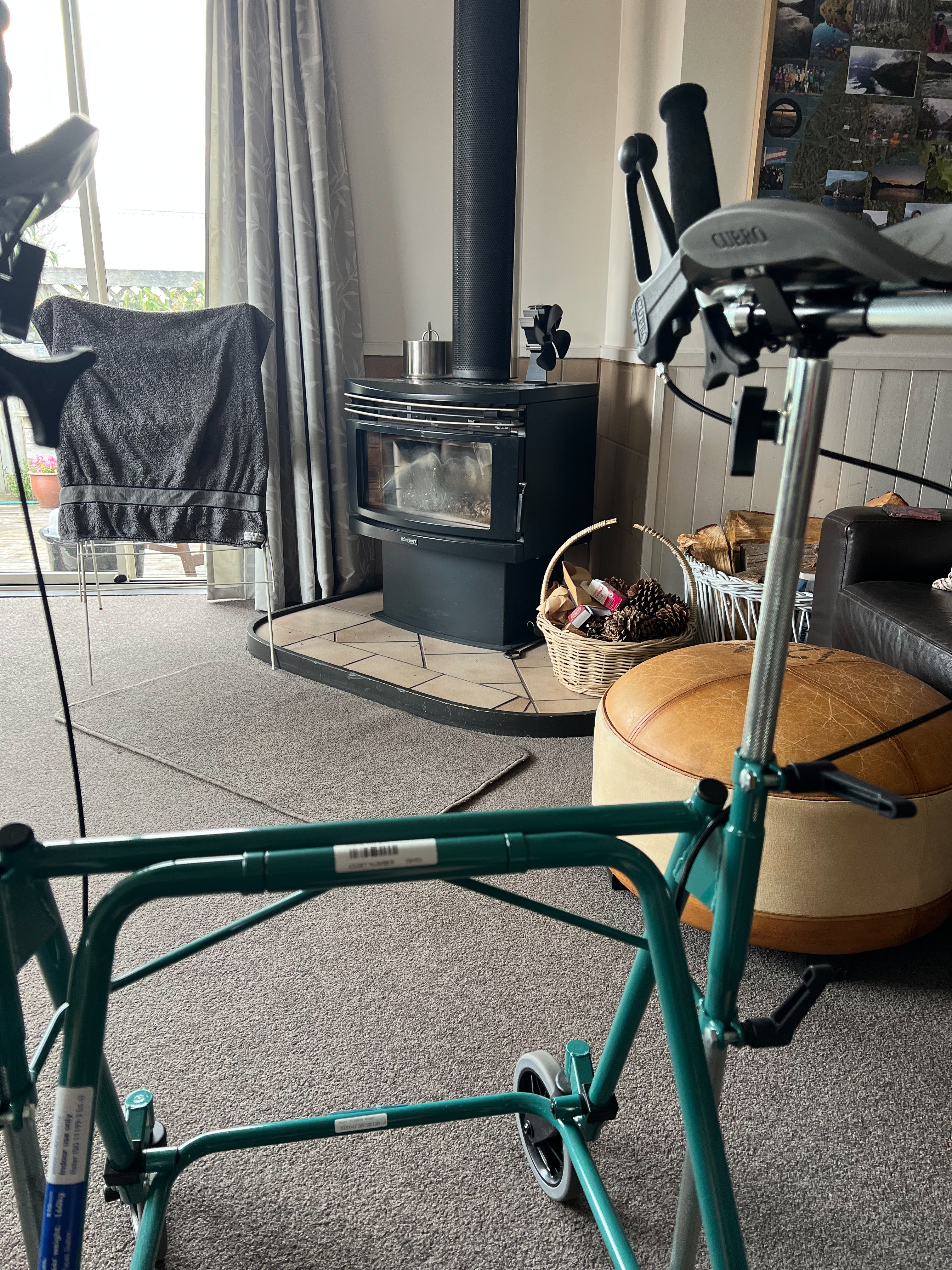
Getting out of bed was the worst! Swinging my leg down onto the ground caused all sorts of pain in my right leg. I'd figured out (advantages of a medical degree) that my right leg pain was due to sciatic nerve involvement, and that the use of Fred, or a rigid leg lifter which the OT department leant me, to brace against helped alleviate the problem. We had briefly discussed the use of medication targeting nerve pain but decided the side effects outweighed the benefits. But I dreaded getting up each morning, and would make sure I had a decent dose of pain medication on board before I made an attempt.
Karen had offered to do all the cooking, and the Dunstan OT had organised to have home help for showering. I was also to get visits from a physiotherapist, all fully funded by ACC. New Zealand's accident insurance system really is a stellar service, when it works, for providing timely care following an accident.
A lot of people asked me about the guy who hit me. Some people got quite angry. Personally, I don't feel any anger at all about what happened, although I do think that there were some serious problems around the number of people on the mountain and about safety in general for all users. My accident highlighted the concerns others had been raising about safety out on the mountain and if that leads to changes, that will be a good outcome. As for being upset about what happened, I can only be grateful that I just broke a few bones (11 in total) and bones heal well. I knew the rehab would be long, but I was pretty sure I would make a full recovery.
So then comes the rehab. Yep, that's next...

